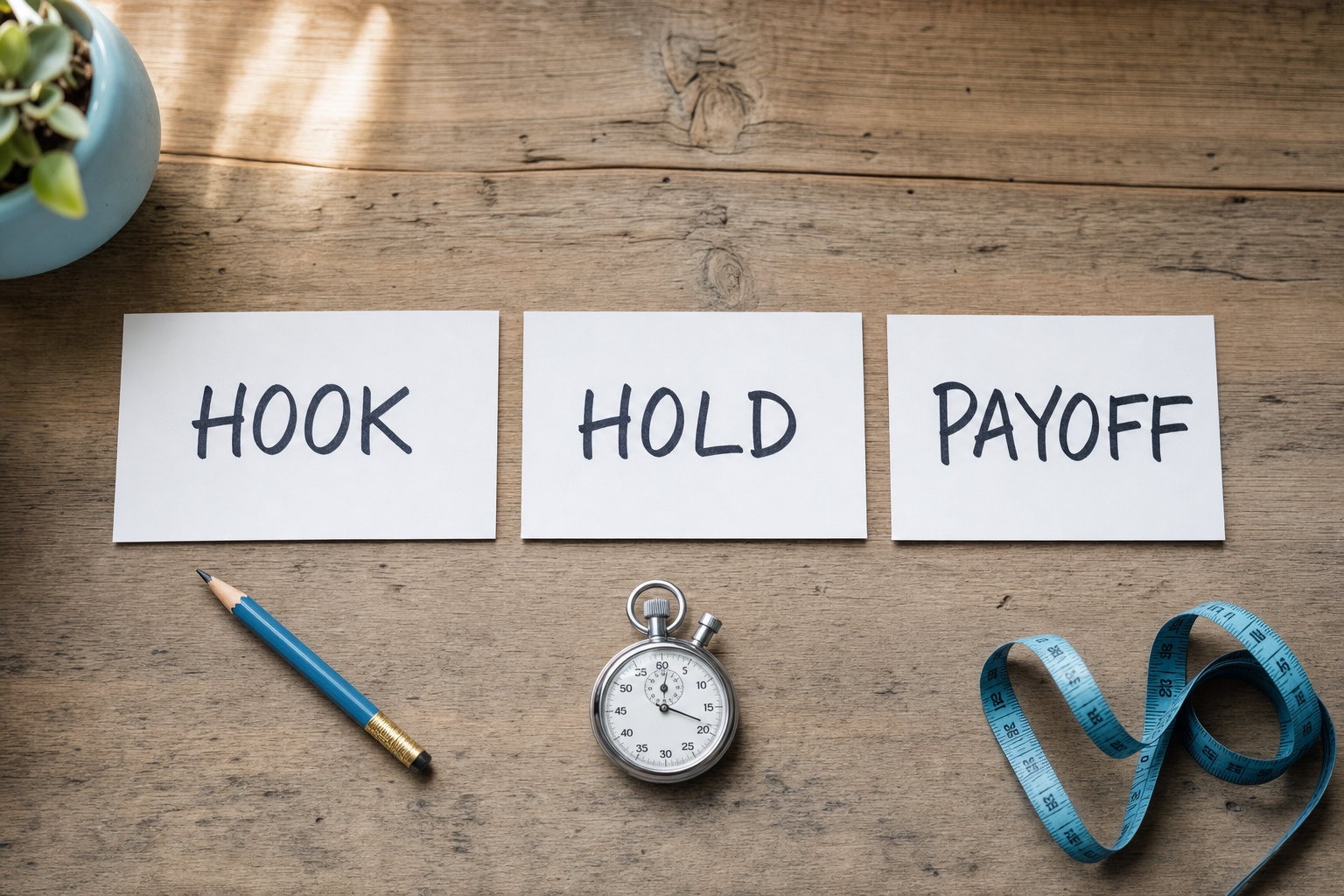
Most short videos die in the middle. The hook lands, people lean in — and then the video wanders, over-explains, and loses them before the point. The fix isn't more editing. It's structure. Hook, Hold, Payoff is a three-act skeleton you can drop any idea into and come out with something tight and watchable. Here are 9 moves that make the template work.
1. Open with the payoff, not the setup
The biggest mistake in short form video script structure is front-loading context. Nobody stays for "So today I want to talk about..." Lead with the promise or the result, then earn it. If your video answers a question, say the answer exists in the first line: "Here's why your reels flatline at 200 views."
- Weak: "In this video I'll explain three things about pricing."
- Strong: "You're undercharging — and here's the exact fix."
2. Write your hook as one sentence you'd read out loud
If your hook needs a comma-heavy run-on to make sense, it's too complex for the first three seconds. Aim for a single spoken line that creates a curiosity gap, a bold claim, or a specific stake. Then say it out loud — if you stumble, rewrite it.
Before you commit, test the opening line against the free Scroll-Stopper Score to see whether it actually earns the pause it's asking for.
3. Cut the throat-clearing between hook and hold
There should be nothing between your hook and the first real beat of value. No intro music sting, no "quick disclaimer," no re-introducing yourself. The transition from Act 1 to Act 2 should feel like a hard cut, not a runway.
4. Build the hold as 2–3 tight beats, not one long ramble
The middle is where videos sag. Break the Hold into a small number of distinct beats — each one a single idea that moves the viewer toward the payoff. Three is plenty for 30 seconds. If a beat needs a beat of its own, it's probably a separate video.
- Beat 1: the core insight or first step
- Beat 2: the twist, contrast, or common mistake
- Beat 3: the shortcut or proof
5. Make every line either advance or earn attention
Read your script and mark each sentence: does it move the story forward, or does it re-hook a fading viewer? If a line does neither, cut it. This single pass is the difference between a 30-second video and a 30-second video that feels like 15.
6. Time-box the script to your target length
Most people speak roughly 130–160 words per minute on camera, so a 30-second video is only about 65–80 words of script. Write to that budget on purpose. If your draft is 140 words, you're not making a 30-second video — you're making a rushed 55-second one.
7. Land the payoff in one clean sentence
The payoff is the moment the hook's promise gets paid off — the takeaway, the result, the "oh, that's the trick." Deliver it plainly and don't bury it under three caveats. If viewers can't repeat your point in their own words after watching, the payoff wasn't clean enough.
8. End with a loop or a next step — never a fade
Don't trail off. Close with a line that either loops back to the hook ("...and that's why the answer was in your first three seconds") or hands the viewer one action. A tight ending is what makes people rewatch and reshare — both of which the algorithms love.
9. Keep the structure, swap the voice per platform
Hook, Hold, Payoff is the skeleton; your tone is the skin. The same script beats can sound different on TikTok versus YouTube Shorts. This is where AI drafting helps — but only if it sounds like you and not a generic brand bot. Teaching a tool your phrasing with Make AI Sound Like You keeps the structure tight without flattening your personality. Inside VibeDay you can turn that script into an AI video for social and adapt it across formats before scheduling.
Key takeaways
- Lead with the payoff, not the setup.
- Keep the hook to one spoken sentence and test it.
- Break the middle into 2–3 distinct beats.
- Budget ~2–3 words per second of finished video.
- Deliver the payoff in one clean, repeatable line.
- End with a loop or a next step — never a fade.
Have a script? Turn it into short videos, schedule them across your platforms, and see what actually holds attention — all in one place with VibeDay.
Start free with VibeDay →Put your content engine on autopilot
VibeDay turns one idea into scroll-stopping posts — image, video, and carousel — captioned for every platform.
Start your free 7-day trial →