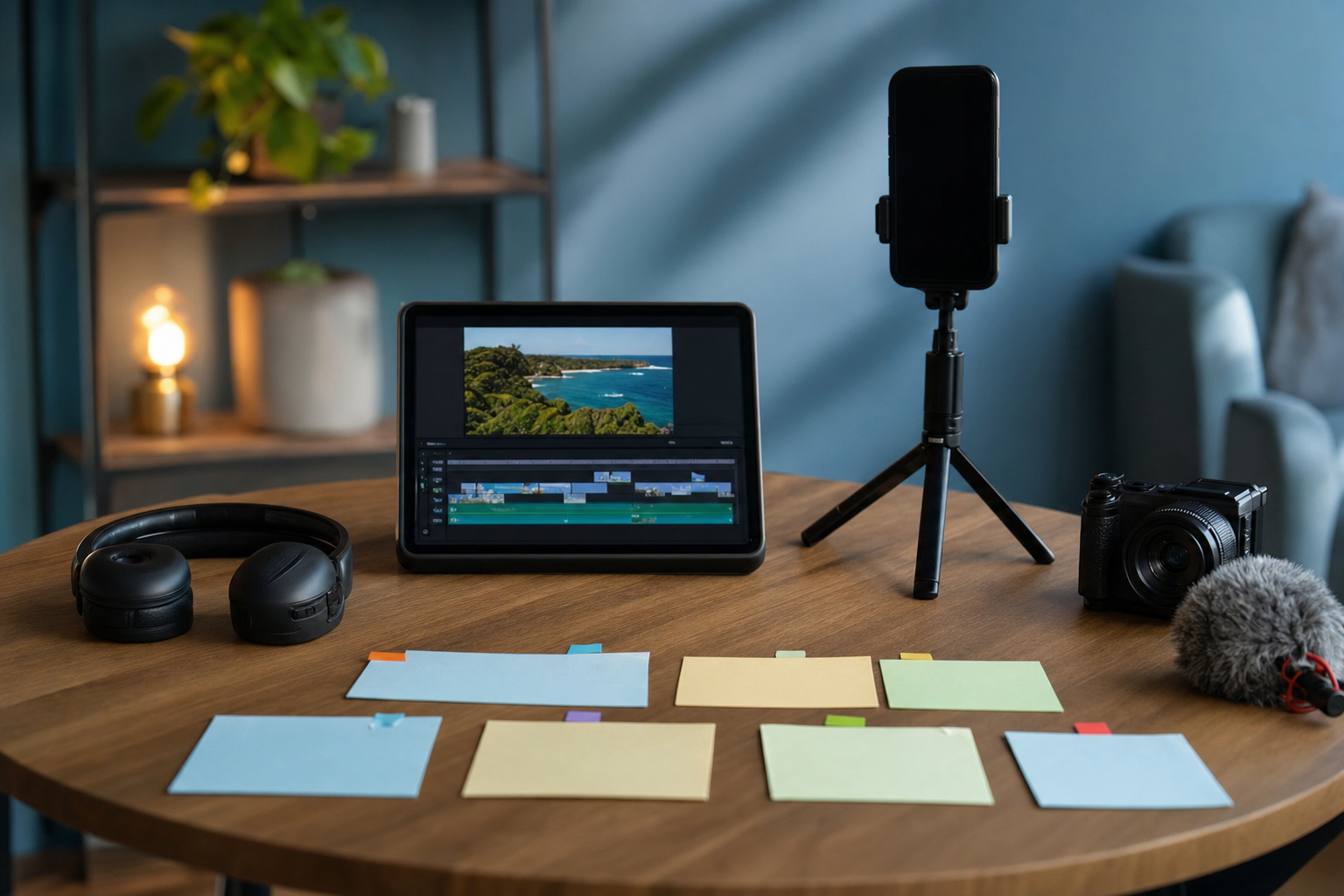

TikTok isn't just a video feed anymore — it's a search engine. People type real questions into that search bar ("how to fix a leaky faucet," "best budget espresso setup," "cozy fall outfits under $50") and TikTok serves them videos that match. The catch: TikTok can't watch your video the way a human does. It reads your content in layers — the words you say out loud, the text you put on screen, and the caption you write. Get keywords into all three layers, and you give TikTok every chance to understand and surface your post.
By the end of this guide you'll have a repeatable process for optimizing every content layer so a single video can rank for the searches your audience is already making — no guessing, no keyword stuffing.
Key takeaways
- TikTok indexes multiple layers: spoken audio (via auto-captions), on-screen text, and your written caption.
- Pick one primary keyword per video and one or two supporting phrases — don't dilute.
- Say your keyword out loud in the first few seconds so it lands in the transcript.
- Add on-screen text that reinforces the same phrase, and write a caption that reads like a real answer to a search.
- Optimizing for search doesn't replace a strong hook — you still need to earn the watch time that keeps you ranking.
Step 1: Find the search phrase before you film
SEO starts with the query, not the video. If you optimize after filming, you're forcing keywords in later. Decide what search you want to win first, then build the video around it.
- Type a seed topic into TikTok's search bar and note the autocomplete suggestions — those are real phrases people search.
- Scroll to the bottom of a search results page and check "Others searched for" for adjacent phrases.
- Pick ONE primary keyword (e.g. "tiktok seo 2026") and one or two supporting phrases you can naturally include.
- Sanity-check demand: if a phrase returns thousands of videos and lots of comments, people care about it.
Step 2: Say your keyword out loud in the first 5 seconds
TikTok auto-generates captions from your audio, and that transcript is indexable. This is the layer most creators ignore — and it's the easiest win.
How to do it
- Open with a line that contains your primary keyword, spoken clearly: "Here's how TikTok SEO actually works in 2026."
- Enunciate — mumbled audio produces a messy transcript that TikTok can't read cleanly.
- Repeat the phrase (or a close variant) once more in the body naturally, not robotically.
- After posting, open the auto-captions and correct any misheard words so your keyword is spelled right in the transcript.
Step 3: Reinforce the phrase with on-screen text
On-screen text is a second indexable layer, and it doubles as accessibility for sound-off viewers. Use it to echo the exact phrase you're targeting.
- Add a bold title card in the first frame with your primary keyword.
- Keep text short and high-contrast so it's readable on small screens.
- Use one or two supporting phrases as section labels through the video ("Step 1," "The mistake everyone makes").
- Avoid burying text behind faces or busy backgrounds where it's hard to read.
Step 4: Write a caption that answers the search
Your caption is prime keyword real estate. Write it like the first sentence of a helpful answer, not a vague teaser.
- Lead with the primary keyword in the first sentence while it still reads naturally.
- Add context or a quick payoff so people know what they'll learn.
- Include 3–5 specific, relevant hashtags — a mix of your broad topic and a niche phrase.
- Skip generic tags like #fyp; specific tags do more for discovery than reach-chasing ones.
Step 5: Don't sacrifice the hook for SEO
Ranking gets you shown; retention keeps you ranked. A keyword-perfect video that people swipe away from will sink. Your opening line has to hook AND carry the keyword — that's the sweet spot.
Before you post, pressure-test your first line with the free Scroll-Stopper Score to make sure it earns the watch time your rankings depend on.
Step 6: Build a repeatable system
One optimized video is a fluke; a system is a strategy. Batch the workflow so every post hits all three layers by default: script the spoken hook with the keyword, add matching on-screen text, and draft the caption before you publish. Tools like VibeDay help you produce AI-assisted video and carousels, schedule them across platforms, and see what performs — so you can double down on the phrases that are actually pulling in searches. (Publishing to each platform stays approval-gated, so you stay in control of what goes live.)
Does TikTok really read what I say out loud?
TikTok auto-generates captions from your audio, and that transcript becomes text the platform can associate with search queries. Speaking your keyword clearly — and correcting any errors in the auto-captions after posting — helps that layer work in your favor.
How many keywords should one video target?
One primary keyword and one or two supporting phrases. Trying to rank for everything usually means ranking for nothing. Focus each video on a single search intent.
Are hashtags still worth using for TikTok SEO in 2026?
Yes, but be specific. A few targeted hashtags tied to your exact topic help categorize your video better than broad reach-chasing tags. Treat them as one more indexable layer, not a numbers game.
Will optimizing for search hurt my reach with regular viewers?
No — if you keep the video engaging. Search optimization adds a second discovery path on top of the For You feed. The only risk is letting keyword placement make your content feel stiff, which is why the hook and payoff still come first.
Ready to plan, create, and schedule search-optimized TikToks without doing it all by hand? Start building your content system with VibeDay.
Try VibeDay free →Put your content engine on autopilot
VibeDay turns one idea into scroll-stopping posts — image, video, and carousel — captioned for every platform.
Start your free 7-day trial →