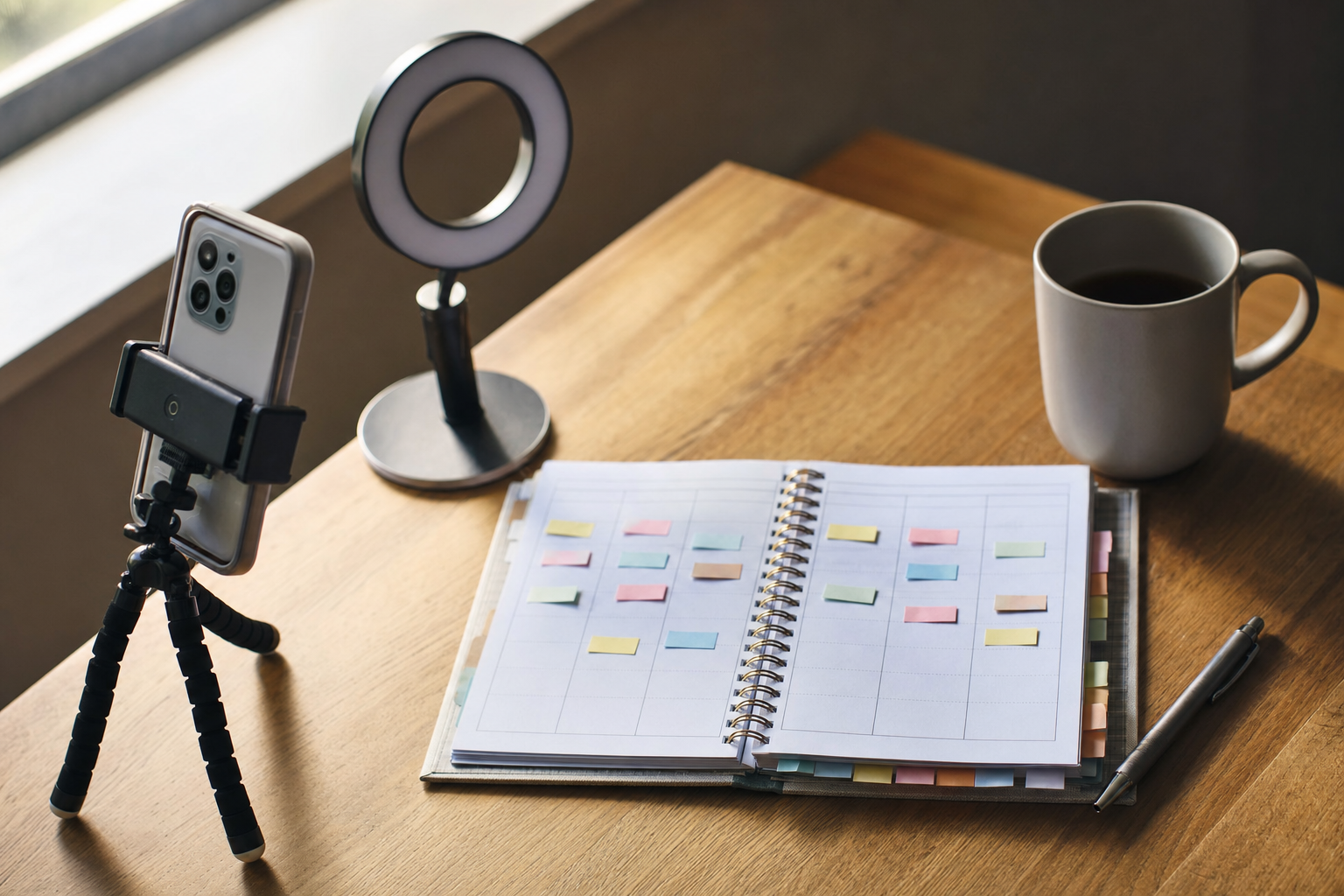

Here's a scene that plays out for a lot of solo founders and small brands: you sit down on a Sunday, feel a surge of ambition, and commit to posting seven times a week on three platforms. By Wednesday you're behind. By Thursday you're skipping. By the following Monday the whole thing has quietly died, and now there's a fresh layer of guilt on top of the actual work.
The problem was never your discipline. It was the plan. A sustainable posting cadence for a small brand isn't the biggest number you can imagine on a good day — it's the number you can hit on a bad week and still keep going. Three posts you'll actually publish beat seven you'll abandon, every single time, because consistency compounds and gaps reset the clock.
Below are the most common mistakes that quietly wreck posting schedules — and the fix for each. None of this requires more willpower. It requires a plan that survives contact with real life.
Mistake 1: Setting the cadence for your best week, not your worst
Aspirational schedules are built on the assumption that every week looks like your most energetic one. But the weeks that matter are the ordinary ones — the week a client emergency eats your Tuesday, or you're sick, or you just don't have a good idea. If your cadence only works when everything else cooperates, it isn't a cadence. It's a wish.
When you miss, it's rarely just one post. Missing breaks the habit loop, and a broken loop is far harder to restart than a modest one is to maintain. The momentum you lose costs more than the extra post you gained on your good weeks.
The fix: pick a frequency you could hit even during a rough week, then treat that as your floor, not your ceiling. If you can comfortably do five but reliably do three, commit to three. You can always post a bonus when inspiration strikes — extra is a gift, not a debt.
Mistake 2: Confusing more posts with more growth
There's an assumption baked into aspirational schedules: that volume is the lever. So people chase seven mediocre posts instead of three they actually thought about. But the feed doesn't reward you for showing up more — it rewards content people stop for, watch, and engage with. A rushed daily post that nobody finishes can teach the algorithm you're not worth surfacing.
Fewer, sharper posts also give you room to do the parts that actually move the needle: a hook worth stopping for, a caption with a point of view, a clear reason to follow you.
The fix: put your energy into the opening seconds. Before you publish, sanity-check whether your first line earns the scroll — you can pressure-test it with the free Scroll-Stopper Score. Three posts with a strong hook will almost always outperform seven forgettable ones.
Mistake 3: Making every post from scratch, every time
The real reason cadences collapse usually isn't the posting — it's the blank page. If each post means brainstorming a topic, writing a caption, editing a video, and finding a time to post, all in one sitting, you've turned a routine into a project. Projects get postponed. Routines don't.
When creation and publishing are fused into one exhausting act, missing a day means missing everything at once. That's why one busy Tuesday can topple the whole week.
The fix: separate the two. Batch your creation when you have energy — make a handful of posts in one focused session — and let scheduling handle the delivery. That's exactly the workflow tools like VibeDay are built for: generate the image, video, or carousel, queue it up, and let the calendar do the remembering. (Publishing to each platform is approval-gated, so you stay in control of what actually goes live.)
Mistake 4: Spreading yourself across every platform at once
Instagram, TikTok, Facebook, YouTube — the temptation is to be everywhere. But each platform has its own rhythms and formats, and trying to feed all of them daily is how a three-post-a-week goal secretly becomes a twelve-post-a-week grind. That math breaks fast.
Being thin everywhere usually beats being present nowhere — but it rarely beats being genuinely consistent in the one or two places your audience actually lives.
The fix: start with the platform where you already get traction and can sustain a real cadence. Reuse and adapt content across the others rather than reinventing it. An AI video for social media can be reformatted into a vertical clip, a carousel, and a caption from one core idea — same effort, more surfaces.
Mistake 5: Treating a missed post as a failure worth quitting over
This is the quiet killer. You miss one day, feel like you've blown the streak, and the all-or-nothing voice says: what's the point? So a single skipped post becomes a two-week silence. The perfectionism that made you overcommit is the same perfectionism that makes you quit.
Consistency isn't a perfect streak. It's a high hit-rate over months. Missing one post out of your weekly three still leaves you posting — and posting beats vanishing.
The fix: build a small buffer. Keep two or three finished posts queued ahead so a bad day draws down your reserve instead of breaking your visible cadence. Then refill when you can. Progress, not perfection.
Key takeaways
- A sustainable posting cadence is the number you can hit on a bad week, not a good one.
- Consistency compounds; gaps reset the habit loop and cost more than extra posts gain.
- Fewer, sharper posts with strong hooks usually beat high-volume, forgettable ones.
- Separate creating from publishing — batch content, then schedule it, so one busy day doesn't sink the week.
- Focus on one or two platforms where you can be consistent, and adapt content across the rest.
- A missed post is normal. Keep a small buffer queued and refill when you can — don't quit over a gap.
Pick a cadence you'll actually keep, batch a week of posts in one sitting, and let the calendar handle the rest. VibeDay helps you create and schedule content that fits real life.
Start with VibeDay →Put your content engine on autopilot
VibeDay turns one idea into scroll-stopping posts — image, video, and carousel — captioned for every platform.
Start your free 7-day trial →